
English Words in Spanish: 5 Curious Origins
Chachi, gringo, sándwich, bistec and orsay: five Spanish words that came from English, and the curious stories behind them.

How long does it take to learn Spanish? Many people start with high hopes and imagine that after a few months in Spain they’ll wake up one morning sounding like Antonio Banderas. For most people it doesn’t work like that, and the honest answer is: it depends. Here’s what affects your speed, why quick fixes backfire and what a realistic timeline looks like.
Spanish is one of the most widely spoken languages in the world, and for English speakers it is a reachable goal. It has its challenges: verb conjugations, pronunciation and the speed of native speakers. But it also has plenty in your favour: lots of vocabulary from Latin, a familiar alphabet and a culture you already know through food, films, TV and music.
Being a native English speaker can actually be a slight disadvantage: because English is spoken so widely, English-speaking countries tend not to prioritise learning other languages. And your background matters: someone exposed to Spanish as a child will usually pick it up faster than someone hearing it for the first time.
Many students come to us with the same story. They signed up for courses promising fast results: conversation or exam success in just a few weeks. Those promises are tempting, but language learning has no shortcut. When the promise isn’t kept, students feel disappointed even when they’ve made real progress, and frustration grows. Many start to doubt their ability, when the real problem was an unrealistic timeline.
Learning Spanish means developing several skills at once: understanding spoken Spanish, answering with confidence, building accurate sentences and adapting to different situations. Each takes time. Progress isn’t linear: some weeks you’ll feel a big jump, others it feels slower, and that’s normal. Rush through the levels and you’ll leave gaps that make real conversations harder later.
To give you a concrete idea, we find that reaching a B1.2 Niveau gives you the essential tools to really live in Madrid. At Jaleo Madrid, that means four courses of five weeks each: a 20-week journey. By the end, you go beyond simple phrases and can handle daily life on your own: visiting the doctor, solving unexpected problems or telling your own stories to Spanish friends.
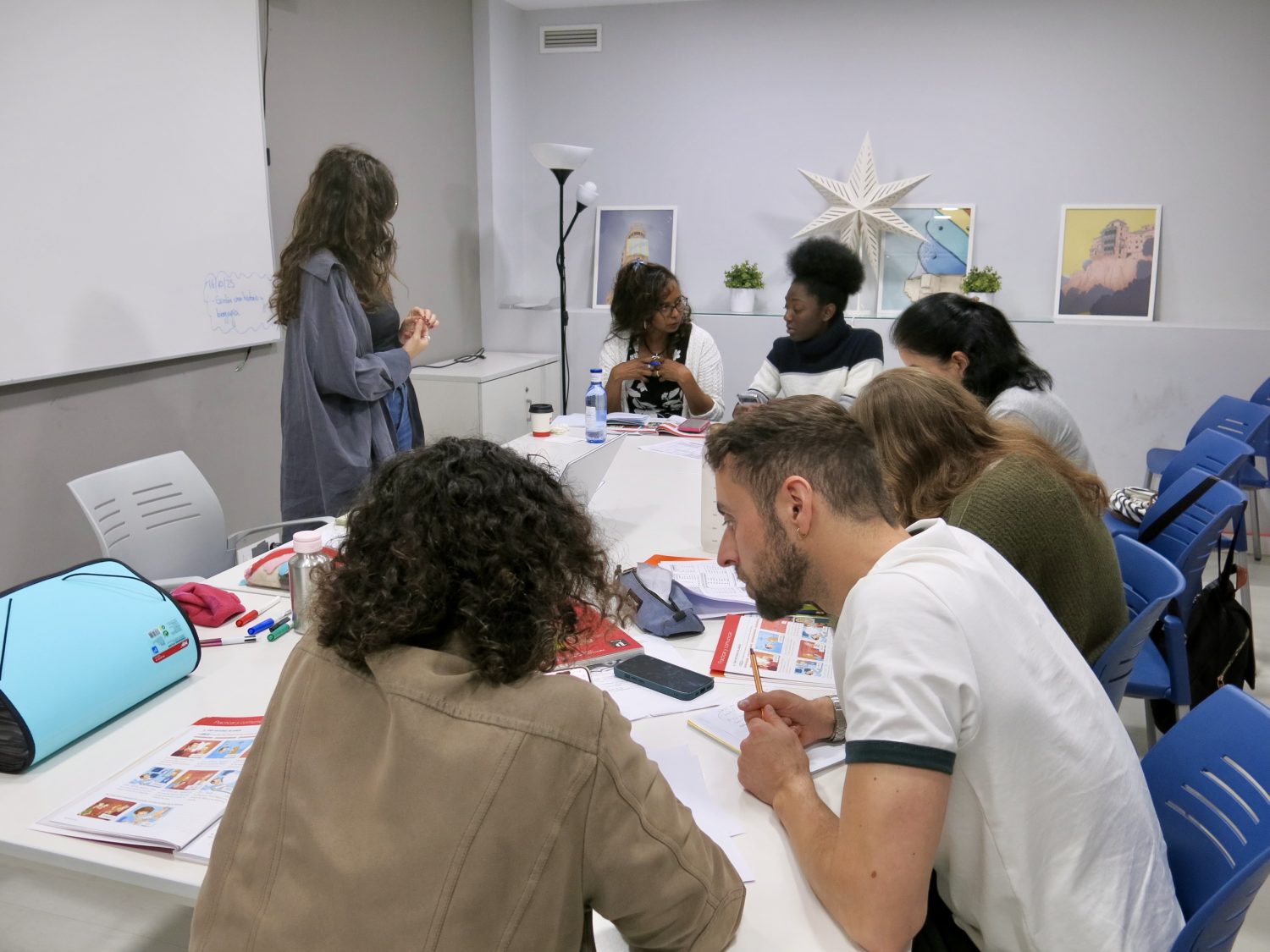
With years of teaching experience, we know how long it usually takes to move from one level to the next. Rather than selling shorter courses to make them more attractive, we choose to be transparent about what each level needs. Knowing what to expect makes students more patient with themselves, protects their motivation and leads to Spanish that lasts. In the end, it’s not about how quickly you reach a level, but how confidently you use Spanish when you get there.
Ready to learn Spanish with a clear, realistic plan? Have a look at our Spanish courses in Madrid, take our free level test und Kontaktieren Sie uns to build a timeline that works for you.
Chachi, gringo, sándwich, bistec and orsay: five Spanish words that came from English, and the curious stories behind them.

SIELE or DELE? Compare how they are marked, their format, flexibility, results and validity to choose the right official Spanish exam for you.

Ten free ways to improve your Spanish at home and around town, from news and podcasts to online workouts and chatting at the supermarket.