Culture shock in Spain, studying abroad in Madrid, American in Spain, Madrid student life, Spanish culture differences: What to expect
Moving to Madrid: exciting… and slightly confusing at times
Studying abroad in Madrid is exciting for many reasons. You imagine improving your Spanish, meeting people from around the world, eating incredible food, and adapting quickly to the local lifestyle. And in many ways, that does happen, often eventually though.
But what many students do not expect is how different daily life can feel, even in small moments. Sometimes the biggest culture shocks are not dramatic at all. They appear quietly in everyday routines: the timing of meals, the pace of conversations, the way people interact in public, or even how long dinner lasts. Going to the grocery store can be different even, and learning Spanish can be a key factor to making this transition easier.
At first, these differences can feel surprising or even frustrating. Over time, however, they often become the exact things students grow to love most about living in Spain. The aspects of the culture of Spain that people fall in love with were once moments of “I am not used to this.”
Au École d'espagnol Jaleo Madrid, we see this transformation constantly. Students arrive expecting to simply “study Spanish,” but quickly realise they are also learning a completely different rhythm of life.
Dinner at 10 PM is completely normal
One of the first culture shocks Americans experience in Madrid is the schedule around food.
In the United States, dinner at 6:00 or 7:00 PM is common. In Madrid, many restaurants do not even begin to fill up until 9:30 or 10:00 PM. At first, students often find themselves starving by the afternoon, confused about why nobody seems ready to eat.
Lunch is also later and usually much longer. Meals are treated as social moments rather than something rushed between obligations. It makes you take time and appreciate life a little more.
In the beginning, this adjustment can feel exhausting. But after a few weeks, many students notice themselves adapting naturally. Suddenly, eating dinner at 6:00 PM starts to feel unusually early. Living in Madrid often changes your relationship with time in ways you do not expect. You live life to the fullest through using your time to the fullest.
The pace of life feels different
Madrid is a busy city, but the lifestyle often feels more balanced than what many Americans are used to. People spend long afternoons sitting at cafés, walking through neighbourhoods, or talking outside restaurants late into the evening. There is a stronger separation between work and personal life, and social connection is prioritised in everyday routines.
For students studying abroad in Madrid, this can initially feel unfamiliar. Many arrive with a mindset focused on productivity and constant movement. In Spain, there is often more value placed on slowing down and enjoying the moment, but still being productive.
This does not mean people are unproductive. Rather, daily life tends to feel less rushed and more intentional. You are stopping to smell the roses metaphorically.
Over time, many students realise that adapting to Madrid is not only about learning Spanish. It is also about learning how to be more present.
Customer service works differently
Another common culture shock in Spain involves customer service expectations.
In the United States, service is often very fast-paced and highly attentive. In Madrid, interactions in restaurants or shops may feel more relaxed and less immediate. Servers usually will not check on your table every few minutes, and in many places, you are expected to ask directly if you need something.
At first, some students may interpret this as unfriendly. In reality, it is simply a different cultural approach.
In Spain, meals are not designed to feel rushed. People may sit at a table for hours talking, and there is generally less pressure to leave quickly after eating. Understanding these differences helps students avoid frustration and appreciate the local culture more naturally.
Greetings become surprisingly complicated
Many Americans are also surprised by social greetings in Spain.
In Madrid, it is common to greet friends or new acquaintances with two kisses on the cheek, especially in social settings. Even students who know this before arriving often feel unsure during their first interactions.
Questions immediately appear:
- Do I go left or right first?
- Is this a handshake situation?
- Are we actually touching cheeks?
- What happens if we both move the same direction?
Almost everyone experiences at least one awkward greeting moment when adapting to Spanish social norms.
However, these interactions quickly become part of daily life. What initially feels unfamiliar eventually begins to feel natural and warm.
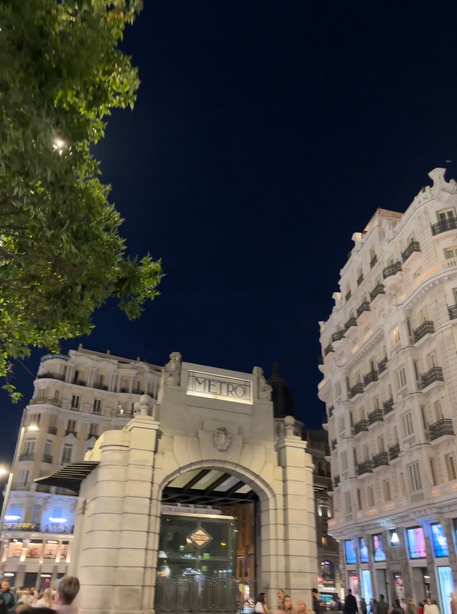
The Metro becomes a vital part of your everyday life
Madrid’s metro system is another adjustment for many students.
At first, it can feel overwhelming: fast-paced stations, crowded trains, different lines, unfamiliar announcements, and people moving with impressive efficiency. But after a short time, students begin navigating the city almost automatically.
The metro becomes part of everyday independence in Madrid. Students learn neighbourhood names, favourite routes, and how different parts of the city each have their own atmosphere and personality.
Eventually, taking the metro everywhere stops feeling intimidating and starts feeling empowering. You have Madrid at your fingertips with the Metro.
Culture shock is part of the experience
Experiencing culture shock does not mean you are doing something wrong. In fact, it usually means you are fully immersing yourself in a new environment.
The moments that feel confusing at first often become the memories students talk about most later on. Adapting to another culture requires flexibility, curiosity, and patience with yourself.
This process is also deeply connected to language learning. The more students interact with local customs, conversations, and routines, the more naturally their Spanish develops.
At Jaleo Madrid Spanish School, we believe cultural immersion is one of the most valuable parts of learning Spanish abroad. Language is not only grammar and vocabulary. It is also understanding the people, habits, humour, and lifestyle behind the words.
Final thoughts: learning more than just Spanish
Studying abroad in Madrid teaches students much more than how to speak another language.
It teaches adaptability, confidence, independence, and cultural awareness. The challenges that initially feel uncomfortable often become the experiences that shape students the most.
The reality is that culture shock is not something to avoid. It is part of what makes living abroad meaningful.
And somewhere between the late dinners, metro rides, long conversations, and awkward cheek kisses, Madrid slowly begins to feel like home.
Ready to experience Madrid for yourself?
At Jaleo Madrid Spanish School, learning Spanish goes beyond the classroom. It is about experiencing the city, connecting with people, and understanding the culture in a real and authentic way.
If you are ready to study Spanish in Madrid and fully immerse yourself in the experience, Jaleo is here to help you begin that journey.