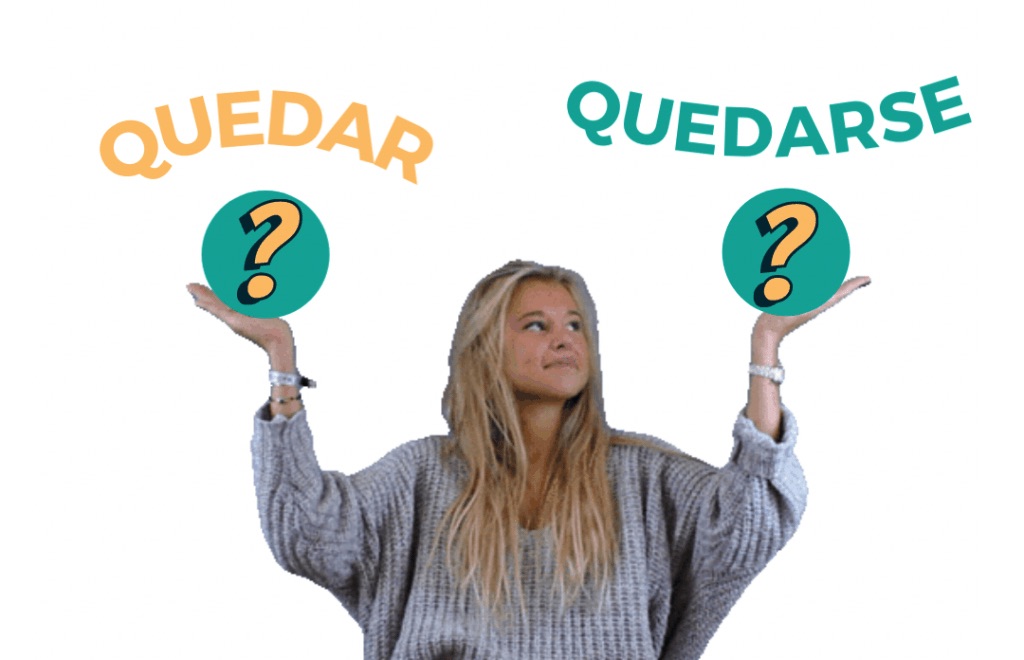
Essential guide: 6 ways to use the verb “quedar” in Spanish

Quedar vs Quedarse

Introduction

The verb “quedar” is undoubtedly one of the most versatile and frequently used verbs in Spanish. Often accompanied by its pronominal form “quedarse”, it holds numerous meanings that can sometimes pose a challenge for Spanish learners. But fear not! We’re here to guide you through its various uses and nuances in this comprehensive post. Ready to master this essential verb?


1. Quedar > to have a date or appointment

We employ the verb “quedar” to express having a date or appointment with someone. This can be used in both informal and slightly formal contexts and is typically followed by the preposition “con”.

  • El domingo quedé con mi madre para comer en un italiano.
  • He quedado con mi hermana para ir al cine el próximo finde.


2. Quedarse > to remain in a place, to stay

Here, the pronominal form “quedarse” is used, functioning reflexively akin to the verb “estar” (to be), indicating the state of remaining in a place.

  • Los viernes por la noche siempre me quedo en casa, no me gusta salir de fiesta.
  • Estas vacaciones nos quedamos en un hotel precioso que tenía piscina.
  • Parece que va a llover, mejor nos quedamos en casa y cenamos aquí.
  • Después de tener a mi hijo, casi todos los días me quedo en casa trabajando.


3. Quedar > to agree upon something

When coming to an agreement or making a decision together, we also use “quedar”, typically followed by the preposition “en”.

  • Hemos quedado en que las clases serían los viernes.
  • Quedamos en que el proyecto estaría listo en tres meses.


4. Quedar > to express the existence of a part of something

In this context, “quedar” signifies the presence or absence of something after an action has taken place. It is always used impersonally, conjugated only in the third person singular or plural.

  • Pedimos tres pizzas y nos comimos casi todas, solo quedaron dos trozos.
  • Queda un poco de melón en la nevera. ¿Puedo comérmelo?, tengo hambre.
  • No queda leche ni zumo, ¿puedes ir al supermercado y comprar?
  • Quedan cinco minutos para que llegue el autobús.


5. Quedar > to suit well or poorly

When discussing someone’s outfit, clothes, or accessories, “quedar” is used to express whether something looks good or bad on a person. Grammatically, it follows a structure similar to the verb “gustar”, using indirect object pronouns (me, te, le, nos, os, les).

  • Al actor que ganó el Oscar le quedaba fatal el traje.
  • ¡Qué bien te queda ese vestido!
  • Me encantan esos pantalones. Te quedan fenomenal, pareces más alta.


6. Quedarse > to undergo a change of state

A common use of “quedarse” is to indicate a person or thing transitioning from one state to another. It can also refer to permanent physical states.

  • Cuando tenía 25 años mi padre se quedó calvo.
  • María se ha quedado embarazada, ¡qué sorpresa!
  • Nos quedamos solos en la oficina hasta muy tarde, teníamos que terminar el trabajo.


Now it’s your turn!

Are you eager to continue practicing? We’ve prepared a quiz to help reinforce what you’ve learned. If you have any questions, recommendations, or simply want to share your thoughts, leave us a comment or send us a message. We’re here to support you on your journey to mastering Spanish!

Happy learning! ¡Feliz aprendizaje!

212
Created on By JaleoMadrid
Quedar vs Quedarse

Quedar o quedarse

Elige la opción correcta. ¡Buena suerte!

1 / 8

Este vestido _____________ genial. ¡Estás guapísima!

2 / 8

"Ya no hay cereales ni leche, ¿puedes comprar?". Esta oración podemos reemplazarla por:

3 / 8

"Este finde estuve en casa y no salí a la calle". Esta oración podemos reemplazarla por: 

4 / 8

Todos los veranos _______ con mis amigos para hacer una barbacoa en mi casa. ¡Es una tradición!

5 / 8

"Se puso muy triste cuando su hermana se fue a vivir a China". Esta oración podemos reemplazarla por:

6 / 8

"Entonces, ¿nos vemos este domingo en mi casa?". Esta oración podemos reemplazarla por:

7 / 8

"Este verano me alojo en un hotel fabuloso" se puede sustituir por:

8 / 8

Hay un problema con el tren y lleva retraso. Todavía _____________ 30 minutos para que llegue.

Your score is

The average score is 81%

0%

Share it!

Facebook
Twitter
WhatsApp

More blog posts

Finding a Job in Madrid

For most of us who have lived here in Madrid a while, we know that finding a job isn’t always easy. When I moved to Spain in 2014 the unemployment rate was a staggering 25% but fast forward 5 years and that number has nearly been cut in half to around 14% today. In order to combat the high costs of labor, many companies have resorted 6 month temporary contracts. If you aren’t one of the lucky ones that already has a job when they arrive, this can make it tough for an expat looking to establish a new life or break-in to a new career. Salaries are much lower around half of what you would make in the US or a two thirds in the UK on average so

Read more »