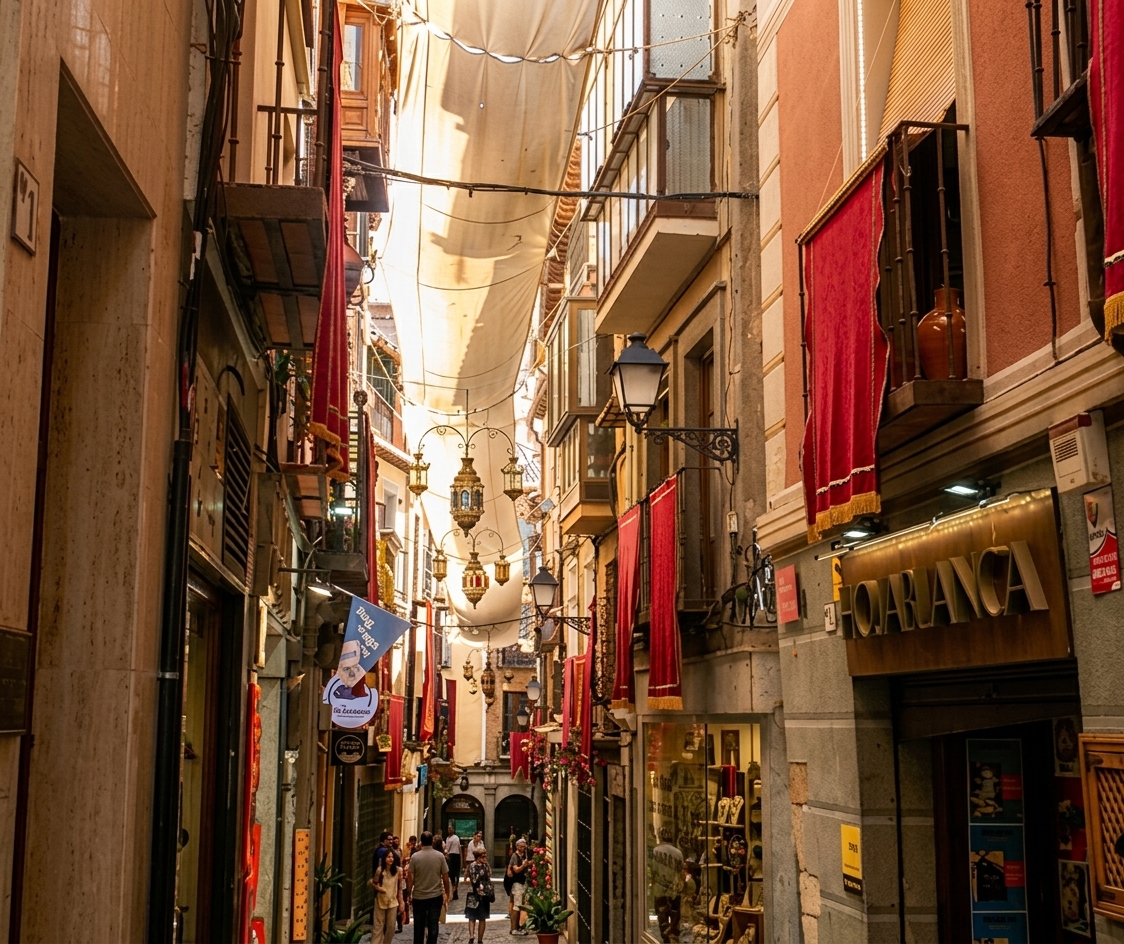
Best Day Trips from Madrid by Train
Toledo in 25 minutes, Valencia in 90, Córdoba in two hours: the best day trips from Madrid by high-speed train, with travel times and highlights.


Our teachers are often asked about the curious slang words students hear around Madrid. These words are full of local flavour, yet they rarely appear in Spanish textbooks for foreigners. Knowing them helps you understand everyday life in the city and fit in a little better, so here are five of the most typical Madrid expressions.
In any conversation between madrileños you will hear “mazo”. The word normally means a mallet, but in Madrid it works as an adverb meaning “very” or “really”.
It adds a touch of intensity that fits Madrid’s lively way of talking. For more ways to say “a lot”, see our guide to saying “a lot” in Spanish like a local.
In standard Spanish, “tronco” is the trunk of a tree. In Madrid, it is also a friendly, informal way to address someone.
Keep it for friends. It is not a word to use with your boss or in formal settings.
If you expect a “mini” to be something small, Madrid will surprise you. Here a “mini” is a 750 ml plastic cup used for drinks like beer, calimocho or sangria, popular in bars and at outdoor gatherings. The same cup has other names around Spain: you might hear “litro”, “katxi” or “maceta”.

When the bill arrives, madrileños often “pagan a pachas”: they split it evenly between everyone. It replaces the old-fashioned “pagar a escote”. You will also hear “pagar a medias” (split the bill) and “pagar cada uno lo suyo” (everyone pays for their own) all over Spain. If in doubt, just make sure you pay your exact share.
“Canteo”, and the verb “cantear”, describe something that is glaringly obvious or over the top.
It is common in Madrid but tricky for non-natives to use correctly, so listen to how locals use it first.
Slang is fun, but the mistakes that give learners away are usually much simpler. English speakers often trip over words that look the same in both languages. Saying “estoy embarazada” to mean “I’m embarrassed” actually means “I’m pregnant”. Translating literally causes problems too: in Spanish you don’t “are” 30 years old, you “have” them: tengo 30 años.
Mistakes are part of learning, and laughing at them makes them easier to remember. For more traps like these, read our guide to Spanish false friends.
These words are just a glimpse of the city’s slang, and each one carries a little of Madrid’s culture. At Jaleo Madrid, our teachers help you understand expressions like these and use them with confidence. If you want to practise them in real conversations, have a look at our conversation classes or get in touch for more information.
Toledo in 25 minutes, Valencia in 90, Córdoba in two hours: the best day trips from Madrid by high-speed train, with travel times and highlights.

Struggling with Spanish verbs? Classroom games, apps and board games that make practising verb conjugation fun, chosen by our teachers.

Aficionado, tapas, siesta, fiesta, mosquito: discover 10 Spanish words you already use in English and other languages, and how their meaning changes.